By Ryan Fatica
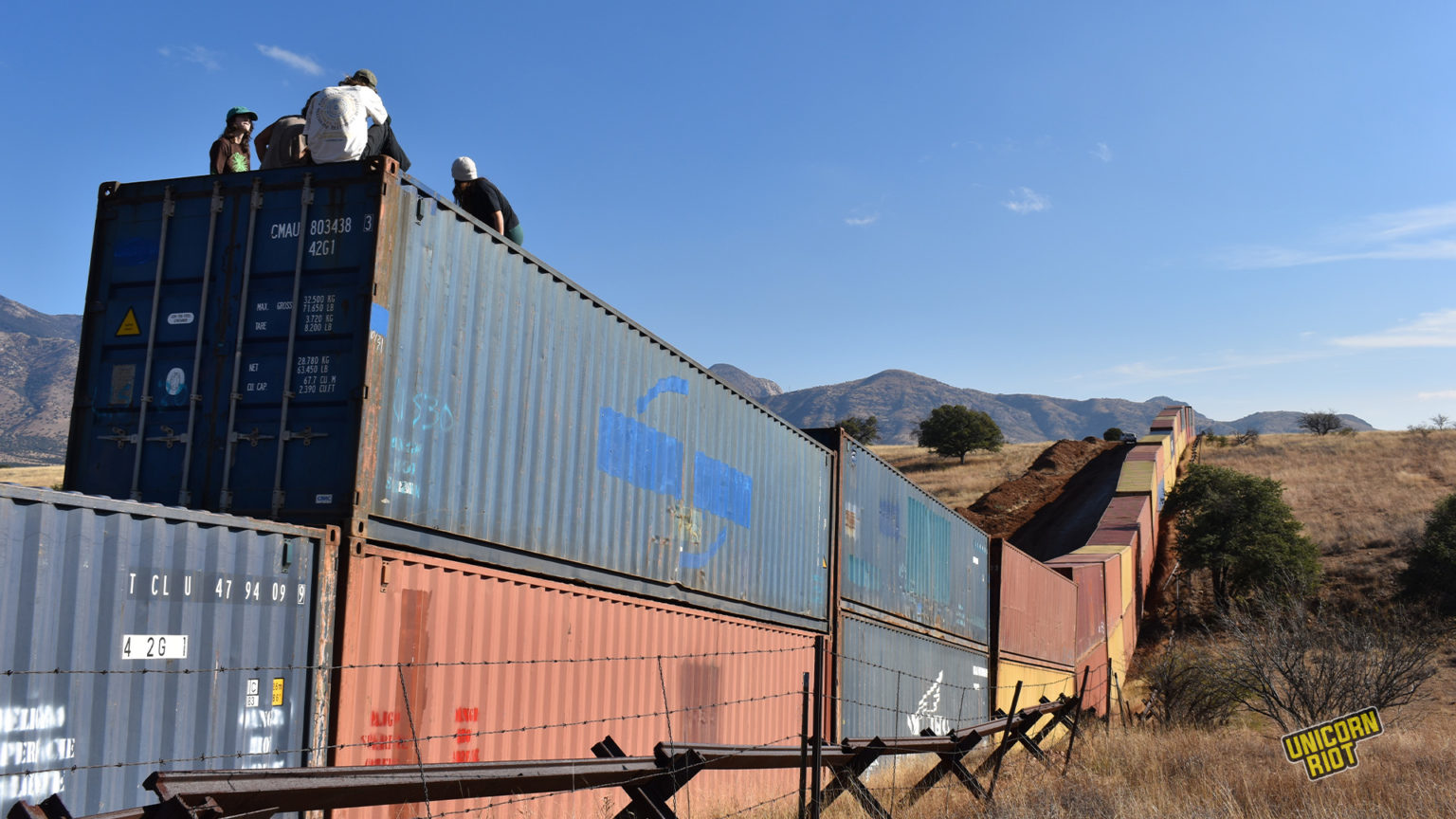
Cochise County, AZ – Seventeen feet above the ground, towering over the native Sonoran grasses and oak saplings of the surrounding bajadas, a group of young people stretched out languidly in the sun, chatting and laughing and playing guitar. In a line to their east, the double-stacked shipping containers beneath them stretched out for over a mile; to their west, the wild grassland lay undisturbed.
On Thursday, at the southern base of the Huachuca Mountains along the U.S./Mexico border, there was little sign of the fight that had unfolded in previous days. The quiet morning stood in contrast to the international geopolitical drama unfolding through this expanse of oak grassland stretching off into Mexico.
Locals say this area is usually quiet, with no evidence of the border crisis they hear about on the news.
In the distance, the crack of a quail hunter’s shotgun disappeared into the silence.
But cutting through the otherwise pristine terrain is a gash of splotched red, blue and yellow stretching patternless through the countryside—column after column of shipping containers stamped white with serial numbers and indecipherable codes, remnants of their nautical journeys.
“They could plant one here but, we’re here,” said Carlee, a blockade participant, as she perched on the edge of a shipping container in the empty space where the next container would lay. As she spoke, she watched long, white clouds drift over the far-off mountains of Mexico.
Since Nov. 29, a loose collection of locals, environmental activists, hippies and migrant solidarity workers have been putting their bodies in the way of the machines. They have successfully delayed the work crews for a week and a half, who had been rushing to drop as many shipping containers into the wilderness as possible before Arizona Governor Doug Ducey leaves office in early January.
What began as a tentative experiment in disruption, escalated to a full-fledged encampment earlier this week. When workers switched to night shifts so they could work unimpeded, blockaders started camping on the site to keep watch.
“We would have two people on each machine trying to stop them,” said Carlee. “And they would just kind of maneuver around people and get really close. And they tried, but we stayed up all night, just making sure that they wouldn’t start moving and going down the hill to excavate more of those trees over there.”
Ary, another blockader, said that at first the workers refused to stop working despite the danger posed to those standing in their way. “At first, they were really driving their machines around us really fast,” explained Ary, as he lay among his friends atop the stacked containers. “Even just the other night, they were still doing that and digging the ground right from under our feet with their excavators, driving very close to people. I think that that just really shows how much money means to these people rather than human life.”
Thursday was the first day the workers didn’t come to the site at all. A private security guard working with the contractors remained on site, sitting in his truck and sometimes chatting casually with protestors to pass the time.
On Friday, workers reported to the site and asked that blockaders allow them to remove their heavy equipment. They loaded up the machines and drove off down the road. For now, at least, it appears the campaign has successfully shut down destruction at this site. Whether work will continue at another section of the border remains to be seen.
“This is what winning looks like,” a protester commented.
Leave a Reply