By Ryan Fatica
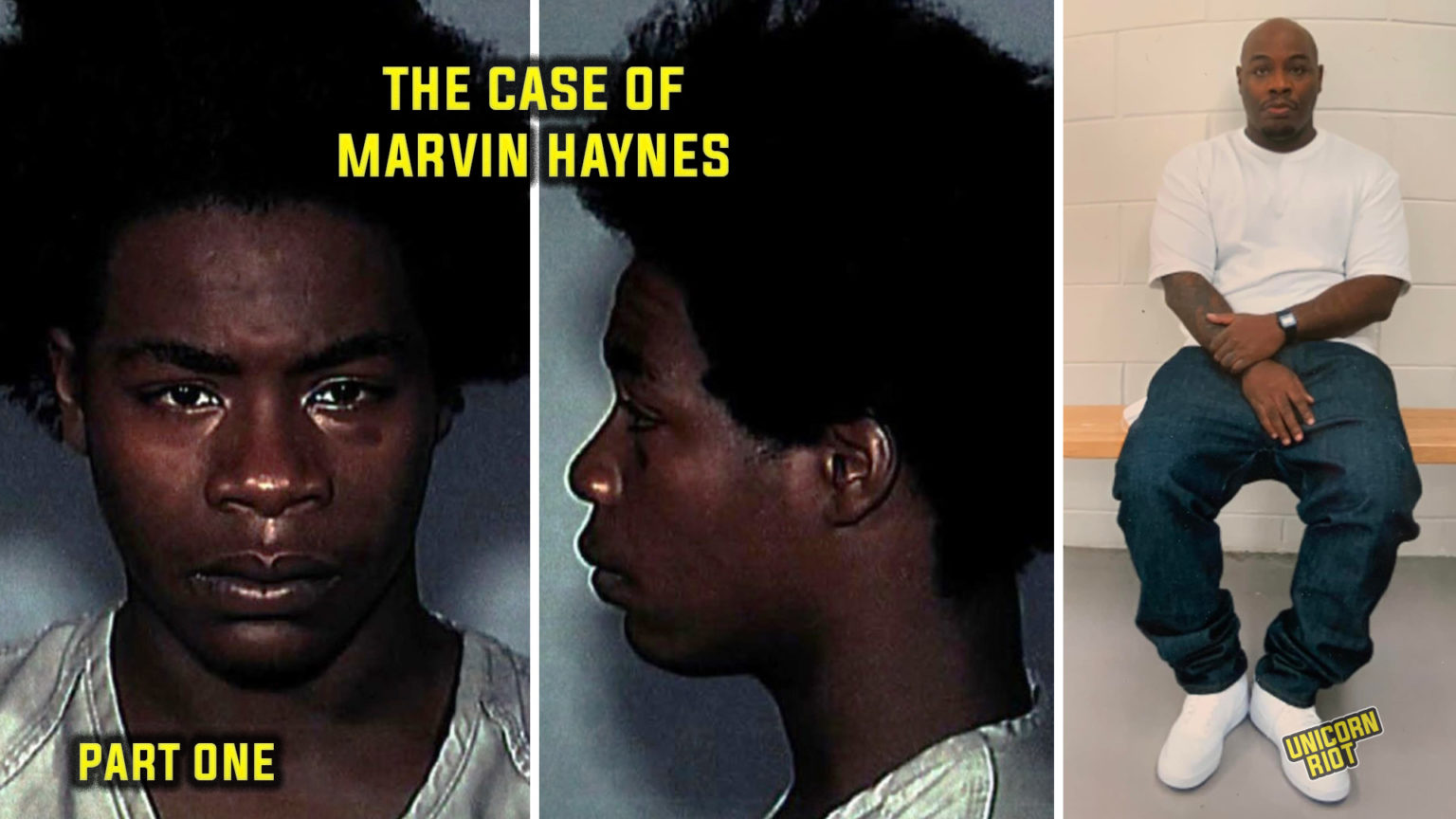
The first of four articles from Unicorn Riot’s investigative series into the case of Marvin Haynes, who was sentenced to life in prison in 2006 at the age of 17 for a murder he says he didn’t commit. Almost a year after this article was originally published, Marvin Haynes was exonerated and released from prison. See the full series here.
Minneapolis, MN – The grainy surveillance camera footage shows a small interrogation room—fifteen-by-fifteen, white walls, short cut-pile dark carpet, circular table, and a blue swivel chair. A door on the far wall stands open to the hallways and cubicles beyond. The date in the corner of the video reads 5-19-04. A counter clicks off the seconds.
A bland-looking cop in a gray suit walks in and directs a young man to the chair. The officer removes his handcuffs.
The kid sits down. As the door closes, he pulls his arms into his short-sleeved shirt against the cold of the air conditioning. He’s 16 years old, 5 feet 7 inches tall, 130 pounds. He’s Black, and he wears a 4-inch Afro, a light blue jail-issue smock, and loose pants of coarse cotton.
He doesn’t know it yet, but in a little over a year, he’ll be sentenced to spend the rest of his life in a prison cell for the murder of Randy Sherer, a white man he says he’s never seen before. A jury will convict him without a shred of physical evidence linking him to the murder.
The kid stares at the wall. He yawns. After a couple minutes, he puts his head down on the laminate surface of the table. He doesn’t look worried. He looks bored.
Five minutes pass. Then seven. Finally the door opens. A white man with gray hair enters the room, wearing a suit. “Hello sir,” he says. A second white cop follows him in.
“How you doin?” the kid responds. “Ey, I didn’t get no receipt that they took my money down to the what’s-its-name,” the kid tells him. He speaks quickly, mumbling, his words difficult to discern.
“I’m sorry?” the man asks. The kid repeats himself, concerned about the small amount of cash the police took from him when they booked him into jail that morning.
“I’m Sergeant Keefe, this is Sergeant Mattson. Your name is what, Marvin? What do you go by, Marvin?”
“Marvin. Little Marvin,” the kid responds. They shake hands.
About six hours before the video starts, Marvin Haynes was picked up by police and told he was being arrested for failure to appear in juvenile court on a previous charge. He was taken to the Hennepin County Juvenile Detention Center before being transported to Room 108 in the Minneapolis Police Headquarters at City Hall for interrogation.
The police read Marvin his Miranda Rights. They tell him he has the right to an attorney.
“I want to have my mom down here,” he responds. The police brush him off, asking whether his mother is a lawyer. During the interrogation, he asks for his mother at least eight times, but the police carry on, sometimes saying they can’t get a hold of her, other times ignoring him entirely.
Seated across the table, the officers ask Marvin about the warrant he was picked up for. He explains that he was trying to get down to court, but he couldn’t make it. He says his mom tried to reschedule it for him, but her phone was turned off. His tone is casual, like he’s trying to clear up a procedural matter.
The officers ask Marvin where he was that weekend. He tells them he was with his cousin Poopy, he was with his girl Muffy, he was trying to get Dee Dee to braid his hair. He slept in until three in the afternoon on Sunday because he was out late with friends Saturday night. He yawns and leans way back in his chair, stretching as he talks. The interrogation continues.
“Do you own any guns at all,” Sgt. Mattson asks.
“No, I don’t own no guns,” Marvin replies.
“We’re investigating an event that happened over in this flower shop off of Glendale, a little bit north of Lowry. You ever been in that flower shop at all?”
“Flower shop? What flower shop?” Marvin asks.
“It’s called Jerry’s Flower Shop…You know Lowry and Lyndale?”
They discuss the cross streets, cardinal directions.
“I ain’t never been in that flower shop,” Marvin responds. “I thought you were talking about Penn ‘cause there’s, like, a flower shop on Penn.”
The police watch Marvin intently when they bring up the flower shop, gauging his reaction. They ask him if he’s seen anything in the news, and he mentions a bus accident he heard about. They prod him, asking how he gets money. Does he have a job?
“No, I get money from girls. All kinds of girls give me money.”
“Why do girls give you money?”
“I don’t know, ‘cause I got it like that,” Marvin says, with a cocky teenage smile. The cops watch him, their faces stern. Did he really just brag about getting girls in the middle of a murder interrogation? Is he a skilled liar or a dumb kid who doesn’t know what’s going on?
Fast forward two-and-a-half hours. Marvin is still in the room, but the scene has changed. Marvin, sobbing, sits in the corner, pulling his shirt up to wipe his tears and running nose. The men are screaming and pointing at him. Their faces contort with the effort. They’ve been lying to Marvin, saying his fingerprints and DNA have been found at the murder scene, that video cameras recorded him entering and exiting the store. They tell him they’re charging him with murder.
Leave a Reply