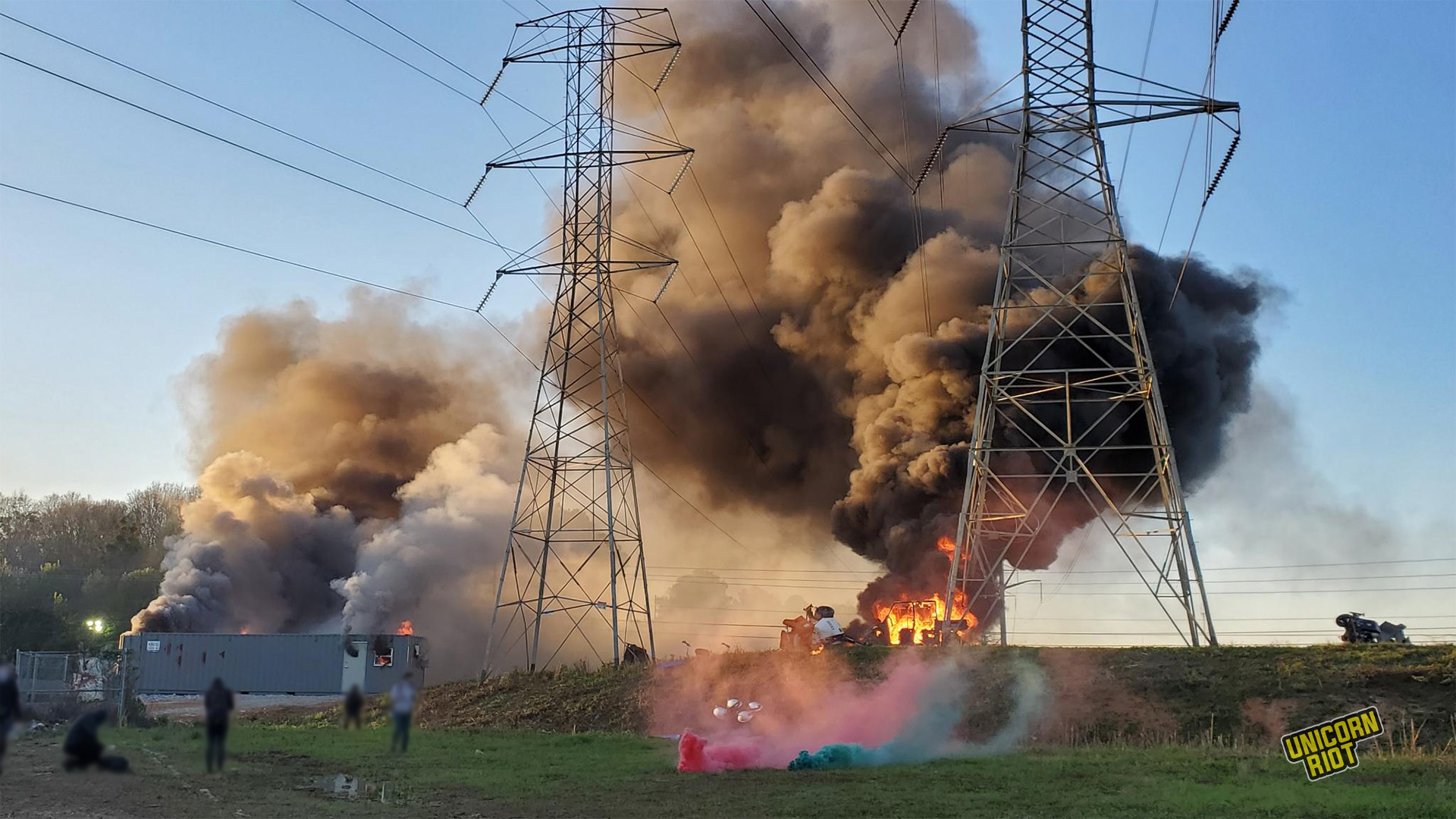
DeKalb County, GA – In broad daylight Sunday, March 5, a group of about three hundred masked people wearing mostly camouflage and black clothing stormed the main police security outpost within the Weelaunee Forest at the proposed construction site of the ‘Cop City’ project. Demonstrators tore up silt fencing, and set an office trailer, two UTVs, a mobile surveillance tower, and a front end loader afire as police ran for cover. The group hurled rocks and fireworks at the retreating police, who repositioned to a smaller outpost across Key Road SE and worked furiously to close a gate behind them to establish a barrier between themselves and the advancing group.
The moment marked an historic turn in both the environmental and police abolitionist movements, as those seeking a climate-adaptive world without police went on the offensive. An action involving this level of mass participation in coordinated sabotage in defense of both the earth and disenfranchised communities is unprecedented in the modern environmental movement in the U.S.
Although urban uprisings against police violence have become a visible part of the modern anti-police movement since at least the Oscar Grant riots in Oakland, California in 2009, these events typically occur shortly after the police kill someone or after the officers responsible go unpunished. In preventing the construction of a police training facility, where cops from across the country will train in urban warfare tactics, the movement in Atlanta doesn’t wait for the police to harm communities, but instead proactively targets the origin of mass production of law enforcement officers and the replication of militarized techniques. In order to provide some insight into Sunday’s action, Unicorn Riot interviewed one anonymous participant about what it felt like, the motivations and strategies grounding it, and the future of the movement.
Unicorn Riot: What was your experience of the action on Sunday, March 5?
Anonymous Participant: I have never seen anything like it in this country. Aside from acts of mass, “spontaneous” rebellion such as riots or uprisings, this was the most serious act of direct action I have ever witnessed a crowd perform. It was hundreds of people in masks, many holding shields. Most wore camo or all-black. The crowd was tight but not in a formation. It wasn’t regimented. This wasn’t a military assault, it was only a march. The sun was up. The weather was warm. The music festival crowd cheered and applauded us as we passed them. I felt safe. I felt calm. The energy was not vengeful or menacing. It was serious, it was bold, but it was light. I really felt like I was with a group of people who want to make the world a better, freer, safer, place. We were chanting “we are unstoppable, another world is possible.” At the time, I really could feel that that was true. When we were close to the [proposed] construction site, we had a police [helicopter] hovering over us, we could see police inside of a fencing staring down at us and we paused. The people holding shields moved to the front. Everyone chanted and called out for those who had rocks or projectiles to move behind the shields. You have to understand, people had different objectives, different tools, dispositions etc. And not everyone wanted to be up front, to hold a shield, to throw objects. Some people were there as medics, or even to just hold space, to be present and supportive in a more unstructured way or an unplanned way I could say. When we approached the gate finally, it was not chaos, but it was something like it. Our crowd unleashed a wild burst of energy. It was incredible and I will never forget it. It was rhythmic almost. We devastated all of their work. The silt fencing, the vehicles, the trailer. Everything.
[Photo by Unicorn Riot]
Leave a Reply